Dining gluten free involves making food choices in a world that isn’t always set up for it. While people can develop effective routines to manage a gluten free diet safely, accidental gluten ingestion is a common reality1,2 – particularly when eating out, attending social events, or travelling.
The ongoing effort to avoid accidental gluten ingestion and the resulting symptoms can lead people to reduce social interactions and travel, and increase caution around food, all of which impact overall quality of life3.
Although the concern is valid, it doesn’t have to be limiting. Understanding what accidental gluten ingestion is, how it happens, and where it is most likely to occur can help people create practical strategies to minimise risk while continuing to enjoy everyday social and dining experiences.
The Reality of a Gluten Free Diet
For people with gluten-related disorders, a strict lifelong gluten free diet is the only treatment available4.
With experience, and often through trial and error, most people following a gluten free diet become highly skilled at avoiding gluten and managing their meals. Challenges often arise when relying on others to prepare food, for example at restaurants, social gatherings, or while travelling, where there’s less control over what happens in the kitchen. In these situations, avoiding gluten depends on other people’s knowledge, training, and attention to detail.
Preparing gluten free food accurately requires:
- Understanding what gluten is and where it can appear
- Reading ingredient labels to accurately identify gluten and contamination risks
- Following safe food preparation, storage, and serving practices to prevent cross-contact
In shared food environments, this level of knowledge isn’t always present, and even with good intentions, mistakes can happen. As a result, accidental gluten ingestion is often part of the reality of eating gluten free in a gluten-containing world.
What Is Accidental Gluten Ingestion?
Accidental gluten ingestion refers to the unintentional consumption of gluten despite efforts to avoid it. Often described as being “glutened”, it isn’t the result of deliberate choice or carelessness. Instead, it reflects the reality that gluten free food preparation is not always perfect, and gluten can sometimes find its way into food intended to be gluten free.
This is most likely to occur when food is prepared outside a person’s direct control, where there is limited visibility over ingredients, equipment, or preparation methods. In these settings, gluten can find its way into gluten free food at various points, from cross-contamination via shared equipment and surfaces to more significant errors such as the use of incorrect ingredients.
As a result, several studies suggest that many people following a strict gluten free diet regularly consume enough gluten to trigger symptoms and intestinal damage5, highlighting how difficult it can be to eliminate exposure entirely, even with careful planning.
Common Causes of Accidental Gluten Ingestion
Accidental gluten ingestion can occur for a range of reasons, including:
- Shared prep environments: Equipment, utensils, or surfaces used for both gluten-containing and gluten free foods during manufacturing, storage, preparation, or service.
- Unclear labelling: Ambiguous, incomplete, or mislabelled ingredient or product labelling.
- Human error: Mix-ups, misreading ingredients lists, unfamiliarity with gluten-containing ingredients, distractions, or simply forgetting.
- Misunderstandings: Miscommunications in busy food environments, differing interpretations of gluten free requirements, and cultural and language barrier difficulties.
Where Accidental Gluten Ingestion Is More Likely
Being aware of where accidental gluten ingestion is more likely isn’t about avoidance – it’s about understanding how to best manage them.
Restaurants & Cafes
When eating at venues that also serve gluten-containing food, the shared environment creates a risk of gluten contamination, misunderstandings, and human error. In fast-paced environments, the likelihood of mistakes or miscommunication increases. Staff may not fully understand the severity of gluten contamination or consistently follow protocols.
Catered Events
These carry the same risk as dining out with the added challenge that food is often served alongside gluten-containing foods in self-serve settings. This means relying not only on the chef preparing the meal correctly, but also on other guests not sharing serving utensils across dishes.
Social Occasions
When food is prepared by family or friends who don’t follow a gluten free diet, mistakes can occur due to less experience with gluten free requirements. Food is often prepared and served alongside gluten-containing items, and shared utensils, buffet setups, and unlabelled homemade dishes can further increase the risk of gluten contamination.
Travelling
Travelling can increase the risk of accidental gluten exposure due to reduced control over food preparation, unfamiliar ingredients, and differences in gluten free standards. Cultural and language barriers can make it harder to communicate requirements or read labels, particularly in new locations.
Takeout & Delivery
Takeaway and delivery orders often involve little to no direct contact with staff, whether in a venue, over the phone, or through an app. This can make it harder to communicate gluten free requirements or ask questions about ingredients and preparation methods. Once the food leaves the venue, there’s limited opportunity to recheck details or identify labelling and packaging errors before eating.
How Accidental Gluten Ingestion Can Affect Life
The possibility of accidental gluten ingestion can be a source of ongoing stress for individuals on a gluten free diet. This stress is driven by the symptoms that may follow exposure, which can vary in type, timing, and severity6-8, sometimes disrupting daily routines or important plans.
Adding to the challenge, symptoms aren’t always easy to link back to gluten, as they often overlap with those caused by other food sensitivities, food poisoning, or gastroenteritis. To learn more, see our blog on symptoms of gluten ingestion in gluten related disorders.
Over time, repeated experiences with accidental gluten ingestion may lead to increased anxiety around food decisions, with some people finding themselves avoiding certain settings, reducing spontaneity, and feeling that staying gluten free demands a high level of control.9
While this caution is understandable, the goal is finding a balance – learning from experiences to refine strategies while maintaining participation in everyday food experiences that support quality of life.
Managing the Risk of Getting “Glutened”
In an ideal world, every gluten free meal would be 100% free of gluten, every time. In reality, for most people, avoiding situations relying on others to prepare gluten free food in shared environments isn’t entirely possible or desirable.
The key is approaching these situations with a strategy to assess risk and set a personal comfort threshold. At the same time, it’s important to accept that accidental gluten ingestion simply happens sometimes despite best efforts. With the right knowledge and preparation, the risk becomes manageable rather than a barrier.
Practical strategies may include researching venue menus ahead of time, asking detailed questions about ingredients and preparation methods, clearly communicating requirements, and making informed choices when selecting gluten free food. While these steps are effective for managing risk, they depend on others following procedures correctly, and that’s where GluteGuard fits into the plan.
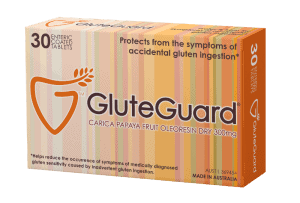
GluteGuard is a pre-meal tablet developed to offer protection* when dining in situations where food preparation isn’t fully within one’s control. It contains Caricain, a natural enzyme from unripe papaya skin, which has the ability to break down the specific gluten peptides known to trigger symptoms in gluten-related disorders.10
Taken 5 to 15 minutes before eating, GluteGuard is designed so that, if gluten is unintentionally consumed, its enzymes are active and ready to help break it down before it triggers a reaction. To learn more about the science behind how GluteGuard works in the body, see here.
Accidental gluten ingestion happens. It’s the reality of living gluten free in a shared food world. The difference between it being limiting or manageable comes down to knowledge and preparation. Understanding the risks, knowing what questions to ask, and having tools available allows people to balance gluten free requirements with quality of life, and enjoy meals out, travel, and social gatherings with confidence.
*GluteGuard helps protect those with medically diagnosed gluten sensitivity from symptoms of accidental gluten ingestion. Always read the label and follow the directions for use.
References:
- Vawser & Associates, ‘Research with people suffering gluten related disorders’, commissioned by Glutagen, July 2020.
- Silvester J, et al, ‘Symptomatic suspected gluten exposure is common among patients with CD on a gluten-free diet’ (2016) 44 Alimentary Pharmacology and Therapeutics 612–619.
- Harnett et. al. (2020) – Quality of life in people with ongoing symptoms of CD despite adherence to a strict gluten–free diet; Nature Research 10:1144
- Biesiekierski, JR. What is gluten?. J Gastroenterol Hepatol, 2017;32:78–81.
- Wieser H, Ruiz-Carnicer Á, Segura V, Comino I, Sousa C. Challenges of monitoring the gluten-free diet adherence in the management and follow-up of patients with CD. Nutrients. 2021 Jun 30;13(7):2274.
- Ludvigsson, J. F., et al. (2014). Gut 2014;63:1210–1228.
- Catassi, C., et al. (2015). Diagnosis of NCGS: The Salerno Experts’ Criteria.
- Sicherer, S. H., & Sampson, H. A. (2014). Food allergy: Epidemiology, pathogenesis, diagnosis, and treatment.
- Satherley RM, Lerigo F, Higgs S, Howard R. An interpretative phenomenological analysis of the development and maintenance of gluten-related distress and unhelpful eating and lifestyle patterns in CD. Br J Health Psychol. 2022 Sep;27(3):1026-1042. doi: 10.1111/bjhp.12588. Epub 2022 Feb 15. PMID: 35170152; PMCID: PMC9544439.
- Tanner GJ. Relative rates of gluten digestion by nine commercial dietary digestive supplements. Front Nutr. 2021 Dec 7;8:784850.